How Bakhtawar Hasan found her way back to art
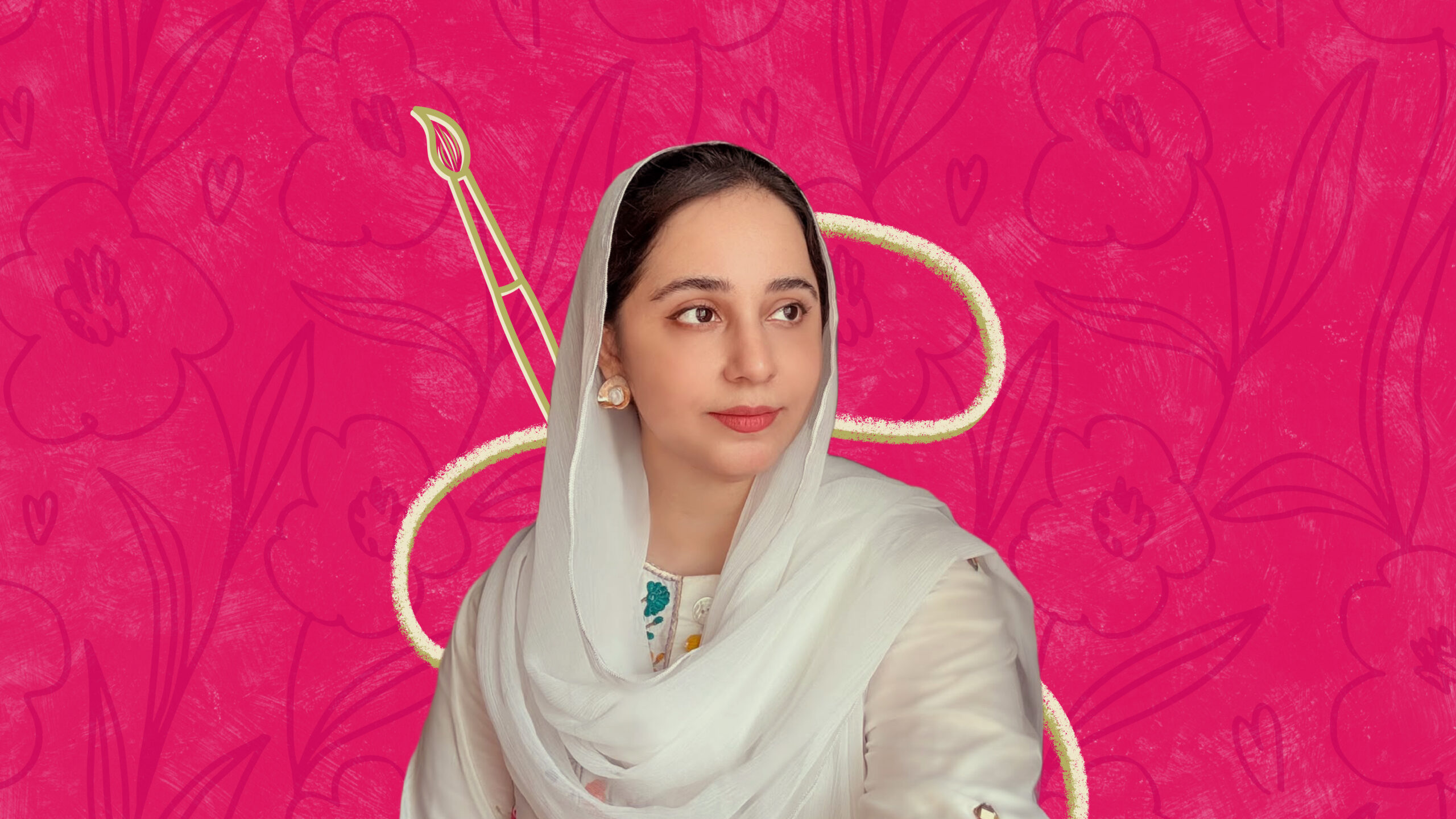
For many women, motherhood arrives with a quiet shift in identity. The center of everyday life changes, leaving little room for the ambitions they once had, not because those ambitions disappear, but because priorities naturally evolve. For Bakhtawar Hasan, the challenge was never choosing between motherhood and career. It was about finding a way to coexist.
Two years into motherhood, she found herself unwilling to go back to the electrical engineering career she had trained for — not wanting to spend her days away from her daughter.
“I still wanted to be with my daughter every moment I could,” she says. “I was too emotionally attached to leave her and pursue a conventional job, so I started working from home where she was always within my sight.”
Bakhtawar had been an artist long before she thought to make a career out of it. She grew up with parents she describes as “super creative,” and art was always part of her life. But instead of pursuing it formally, she studied electrical engineering at the National University of Sciences and Technology (NUST), a field that has little to do with art. She now credits it with something she still relies on: a respect for structure that matters to her work as much as imagination does. She believes it continues to shape how she runs her art page. The problem-solving and structured thinking she picked up as an engineer now help her manage the parts of being an artist that have little to do with art itself, communicating with clients, building an audience, and understanding the business side of the work.
In 2018, she started Youtoonify to make illustrations people could connect with. The name came from the idea of “toonifying” someone: turning them into art in a way that felt memorable and easy to find. It began as a page for commissions and grew from there into children’s storybooks, wedding invitations, cultural illustrations, and collaborations. Her work has since been featured through projects with Paramount Books, campaigns for the Ministry of Health, and exhibitions at the Pakistan Military Academy, celebrating inspiring Pakistani women.
Her creative process starts with imagination. An idea usually arrives whole in her mind before she begins: rough storyboards first, then sketching, color blocking, and finally highlights and shadows. The illustration keeps changing shape again and again until it matches what she first pictured. Where the ideas themselves come from is simpler than it sounds. She pays attention to the world around her. “Everything we observe becomes part of our visual vocabulary,” she says.
“I love noticing human features, nature’s wonders, architectural details, and the emotions people carry.”
It shows up in what she chooses to draw. Her illustrations carry pieces of culture, everyday life, and human emotion as stories held inside an image. Motherhood has shaped those stories, too. “I am who I am because of my Maham,” she says. “She is my full moon, my light.”
Turning a passion into a profession has come with its own difficulties. Like many artists working online, Bakhtawar has had her work copied and used without permission “more times than I can count.” It remains painful, she admits, but it hasn’t changed how she works. She doesn’t let those experiences define her relationship with art.
There’s also a constant negotiation between creating for others and creating for herself. “Some work is created purely from the heart, while some is created to bring a client’s vision to life,” she says. When commissioned work starts to feel distant from her own, she goes back to personal pieces.
Perhaps that’s what has let her keep growing through every change of phase. For Bakhtawar, control was never about eliminating uncertainty, it was about learning to move through it.
“Nature has taught me that what appears chaotic often follows an unseen rhythm,” she says. “My journey has simply been about learning to trust that rhythm.”
Youtoonify began as a way to make space for both motherhood and creativity. Years later, it has become something more — a reminder that a new chapter doesn’t always replace the one before it. Sometimes it just gives it a different shape.
YOU MIGHT ALSO LIKE
After the Pause
How Bakhtawar Hasan found her way back to art For many women, motherhood arrives with…

Celebrating the Passion of Nayyar Alvi by Remembering the True Spirit of Journalism
The passion used to exist decades back, some twenty-five years ago, before his pen finally…

With Him, They Conquer
On my morning commute to university, I witnessed a small, quiet moment: a father dropping…

LONG LIVE THE COMPUTERS
It has finally happened. All those wild futuristic movies about robots replacing, displacing, and inevitably…

FROM TABOO TO TALK
There was a time when the word period was never said aloud, not in schools,…

A GENERATIONAL TRAUMA ASKING FOR SPEAK OUT
After receiving my offer letter for an IT internship, I stepped into what I thought…